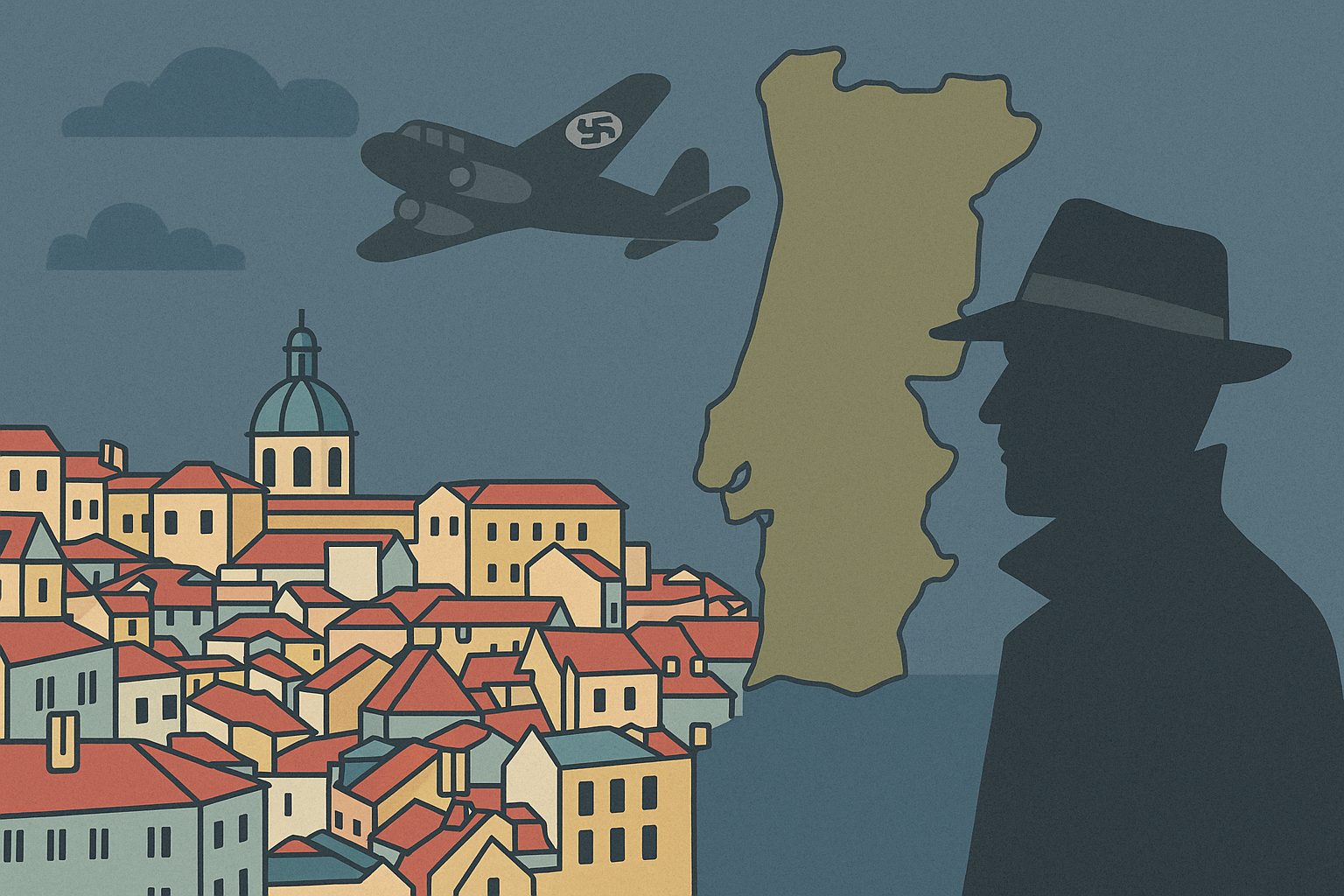
When we think of the Second World War, images of bombed-out cities, occupied territories, and fierce battles immediately come to mind. Lisbon, however, tells a different story. Portugal, under the authoritarian rule of António de Oliveira Salazar, declared neutrality at the start of the war. This neutrality transformed Lisbon into a unique place in wartime Europe: a city untouched by bombing, yet buzzing with intrigue, diplomacy, espionage, and the desperate hopes of thousands of refugees seeking a way out of the continent. While much of Europe was engulfed in destruction, Lisbon became a lifeline to the free world, a stage for spies, and a haven of escape. Below we explore the most frequently asked questions about Lisbon during the Second World War.
Was Portugal neutral during World War II?
Yes, Portugal maintained neutrality throughout the conflict. Salazar skillfully balanced relationships with both Axis and Allied powers. Portugal had a long-standing alliance with Britain, dating back to the 14th century, yet it also maintained trade relations with Germany. This delicate balancing act allowed Portugal to avoid direct involvement in the war, preserving its cities, including Lisbon, from devastation.
Did Lisbon suffer bombings during WWII?
No. Unlike other European capitals, Lisbon was spared the horrors of aerial bombardment. The city remained intact throughout the war years. This alone made Lisbon a beacon of safety for refugees and diplomats. Hotels remained open, cafés bustled with life, and ships continued to sail from its harbor while much of Europe lay in ruins.
Why was Lisbon important in WWII?
Lisbon became one of the few functioning gateways out of Europe. Its strategic Atlantic port allowed ships to sail to the Americas, and its airports connected travelers to North Africa and beyond. Refugees who had lost everything could still reach freedom via Lisbon. At the same time, the city was a hub for information gathering. Diplomats, journalists, spies, and traders all converged in Lisbon, making it a critical node in wartime networks.
Did Jewish refugees pass through Lisbon?
Yes, Lisbon became a crucial escape route for Jewish refugees fleeing Nazi persecution. Thousands of Jews who had managed to cross the Pyrenees into Spain eventually found their way to Lisbon. From here, they boarded ships bound for the United States, Brazil, and Palestine. The city’s role as a point of transit saved countless lives. Lisbon’s streets, cafés, and embassies were filled with exhausted refugees hoping to secure passage to safety.
Could you really catch a ship to freedom from Lisbon?
Yes. Lisbon’s harbor remained one of the last open doors to freedom during the war. Ships like the Serpa Pinto regularly carried passengers to New York, Brazil, or Havana. Tickets were expensive and scarce, but for many refugees this was the final chance to escape Nazi-occupied Europe. The city became a place where lives balanced on a knife’s edge—secure a ticket, and you had a future; fail, and you risked being trapped once more.
Was Lisbon full of spies during WWII?
Absolutely. Lisbon earned the nickname “City of Spies.” British, American, German, and Soviet agents filled the city’s cafés, hotels, and nightclubs. Information was traded constantly, as agents watched each other, tried to influence Portuguese officials, and intercepted valuable intelligence. Espionage thrived in Lisbon precisely because of its neutrality: it was a place where enemies could move in close proximity without openly clashing.
Did Lisbon inspire spy novels or movies?
Yes. The atmosphere of Lisbon during the war—its crowded hotels full of refugees, its smoky cafés filled with whispering men in trench coats, its ships ready to cross the Atlantic—inspired many writers. Graham Greene, who worked for British intelligence, drew inspiration from wartime Lisbon. The city has often been compared to Casablanca, another legendary port of intrigue. To this day, Lisbon retains a sense of mystery tied to its WWII reputation.
Did Portugal secretly help the Allies?
Although neutral, Portugal did lean toward the Allies at crucial moments. A key example was tungsten (wolfram), a mineral critical for armaments. Portugal exported tungsten to both Germany and Britain, but as the war progressed, it increasingly supported the Allied side. In 1943, Portugal granted Britain and the United States access to air bases in the Azores, which became essential for controlling Atlantic shipping lanes and launching operations.
Was life in Lisbon normal during the war?
Life in Lisbon was unusual: both normal and extraordinary at the same time. On the surface, daily routines continued. Trams ran through the streets, markets stayed open, and the city’s cafés and fado houses remained lively. Yet beneath this calm, Lisbon was filled with uncertainty. Food shortages and rationing occurred, though less severely than in much of Europe. The city was crowded with refugees, diplomats, and spies, creating an atmosphere unlike any other in Europe at the time.
Did famous people pass through Lisbon?
Yes, many notable figures found themselves in Lisbon during the war. The Duke and Duchess of Windsor transited through Portugal after fleeing France. The artist Marc Chagall was among the many Jewish refugees who passed through Lisbon on their way to the United States. Politicians, aristocrats, intellectuals, and writers all crossed paths in the city, turning Lisbon into a cultural crossroads during Europe’s darkest years.
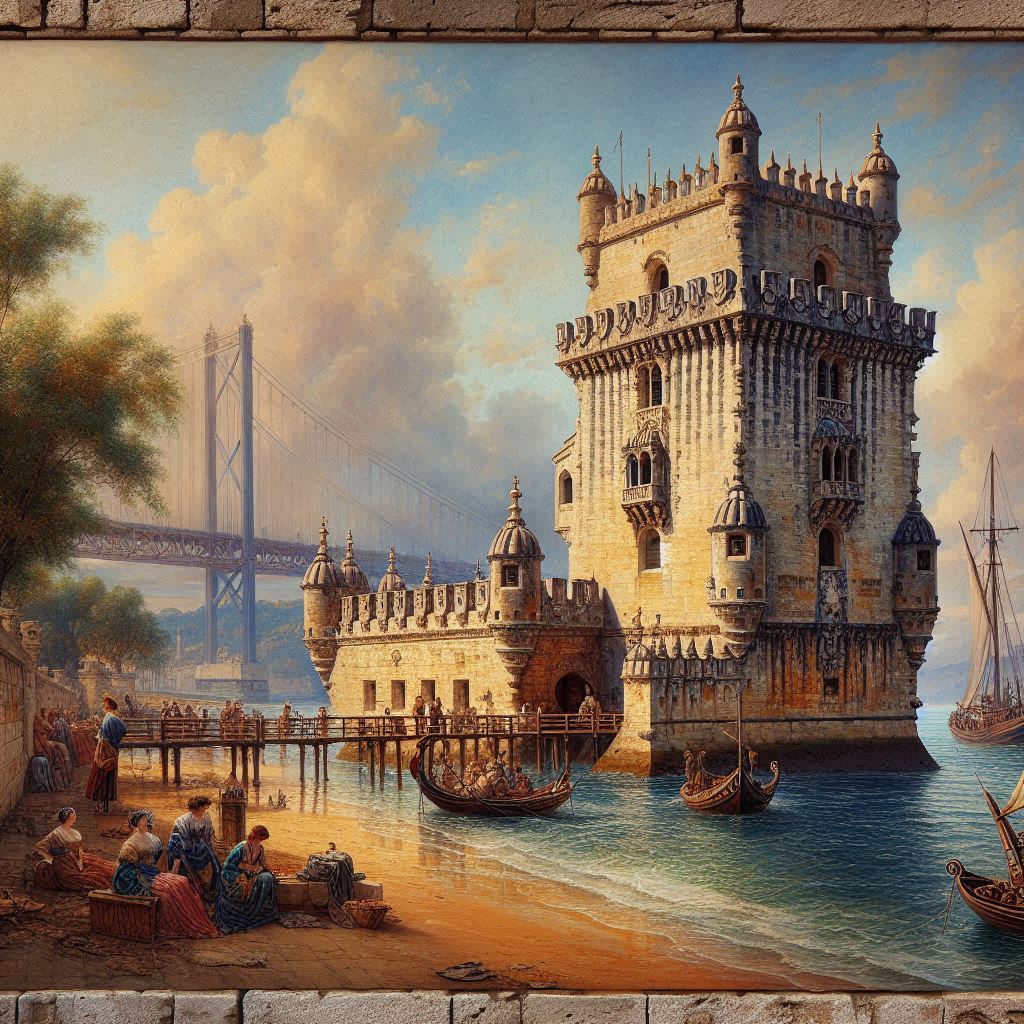
Aristides de Sousa Mendes – The Portuguese Hero
Aristides de Sousa Mendes was the Portuguese consul in Bordeaux in 1940. Against Salazar’s strict orders, he issued thousands of visas to Jewish families and other refugees, allowing them to escape through Portugal to safety. Many of them continued their journey via Lisbon to other parts of the world. Although he was punished by the regime at the time, today he is honored as a national hero of Portugal and recognized by Yad Vashem as one of the Righteous Among the Nations.
Can Sousa Mendes Be Compared to Raoul Wallenberg or Oskar Schindler?
Can Aristides de Sousa Mendes be compared to Raoul Wallenberg in Budapest or Oskar Schindler in Krakow? In many ways, yes. Just as Wallenberg saved Budapest’s Jews with protective passports and safe houses, and Schindler shielded his workers from deportation by employing them in his factories, Sousa Mendes used his diplomatic authority to issue visas that saved thousands of lives. All three operated in different environments: Wallenberg in Nazi-occupied Hungary, Schindler at the very heart of the German system, and Sousa Mendes in neutral but authoritarian Portugal. What unites them is moral courage and conscience: they chose humanity over blind obedience. While their circumstances and methods were not the same, they remain powerful examples of how individual decisions can resist overwhelming evil and alter the course of countless lives.
Five Books Worth Reading to Better Understand Lisbon and Portugal During the Second World War
1. Neill Lochery: Lisbon: War in the Shadows of the City of Light, 1939-1945 – Perhaps the most comprehensive historical account of the subject. It vividly explains how Lisbon became a center for refugees, spies, and diplomats, while Portugal maintained its delicate neutrality.
2. Ronald Weber: The Lisbon Route – Entry and Escape in Nazi Europe – Focuses specifically on the escape routes that passed through Lisbon. The book shows how crucial the city was as a gateway for those fleeing Nazi persecution.
3. Anne Sebba: Les Parisiennes (sections on Lisbon) – Although primarily about Paris, this book touches upon Lisbon as a vital transit point for French women and refugees. It situates Lisbon within the broader wartime European network.
4. David Lodge: Author, Author! (fictional perspective with Lisbon references) – A novel that blends literature, history, and the refugee experience. While fictional, it captures the unique atmosphere of the city during the war years.
5. David Leite: The New Portuguese Table (with cultural and culinary insights) – Not strictly a WWII history book, but it provides insight into Portuguese life and culture, including food and traditions that carried on even during the war years. It complements historical works by offering a more human and cultural perspective.
Together, these books – ranging from strict history to fiction and cultural reflections – provide a fuller picture of what life in Lisbon and Portugal was like during the turbulent years of the Second World War.
Conclusion
Lisbon during the Second World War was a paradox: a city at peace in a continent at war. It was a haven for refugees, a playground for spies, and a delicate balancing act for Portugal’s leaders. While much of Europe was in ruins, Lisbon remained intact, its role as a neutral port making it a last lifeline to freedom. Today, its wartime legacy lives on in stories of courage, like those of Aristides de Sousa Mendes, and in the memory of thousands who passed through its streets on their way to safety. For travelers and history enthusiasts, Lisbon offers not only beautiful architecture and sunny squares, but also a deep and fascinating connection to one of the most turbulent times in modern history.


