Lisbon has become one of Europe’s most sought-after destinations, and with that popularity has come a noticeable shift in pricing. While Portugal remains more affordable than its neighbors to the North, the capital now reflects the cost of a bustling, cosmopolitan metropolis. In 2026, Lisbon offers experiences for every budget, from the traditional tascas of Alfama to the sophisticated rooftops of Príncipe Real.
To manage your budget effectively, it is worth noting that while card payments are widespread, “cash is king” in many small bakeries and traditional local establishments.
🍺 Beer: Imperiais and Craft Brews
In Lisbon, you don’t just ask for “a beer”; you ask for an “Imperial” (a small draught beer). While the market is dominated by the classic Sagres and Super Bock, the craft beer scene has exploded in neighborhoods like Marvila.
Imperial (0.20L – 0.30L): €1.50 – €2.50. In a local neighborhood tasca, you can still find them for €1.20, but expect to pay more on the terraces of Chiado.
Craft Beer (0.40L): €5.00 – €8.00. Local brands like Musa or Dois Corvos are popular choices in modern bars.
Supermarket (0.33L Can): €0.80 – €1.20.
☕ Coffee and the Essential Pastel de Nata
Coffee culture is the heartbeat of Lisbon. The “Bica” (espresso) is a daily ritual, almost always accompanied by the crown jewel of Portuguese pastry.
A Bica (Espresso): €0.70 – €1.00. In tourist-heavy plazas, prices can climb to €1.50.
Pastel de Nata: €1.10 – €1.50. A custard tart at a local pastry shop costs around €1.10, while at the famous Pastéis de Belém or Manteigaria, the price is slightly higher due to their artisanal reputation.
Coffee + Nata Combo: Many local cafés offer this classic “breakfast” for between €2.00 and €2.50.
🚕 Taxis and Ride-Sharing: An Efficient Network
Lisbon has excellent coverage of traditional taxis (beige or black-and-green) and ride-sharing platforms (TVDE) like Uber and Bolt.
Taxi Base Fare: €3.25.
Average City Center Trip: €7.00 – €12.00.
TVDE (Uber/Bolt): Prices fluctuate with demand, but a 15-minute trip generally costs between €6.00 and €10.00.
Pro Tip: From the airport, the Metro (€1.80) or a ride-share app is usually more cost-predictable than a traditional taxi, which may charge extra for luggage.
🍽️ Dinner: Flavors of the Atlantic
From Bacalhau à Brás (shredded cod) to fresh grilled sea bass, dining out in Lisbon is a social must.
Budget Meal (Prato do Dia): €8.50 – €12.00. This “plate of the day” usually includes a main course and coffee, and sometimes a drink, found at local spots during lunch.
Mid-range Dinner (3 courses for one): €20.00 – €35.00. In a cozy restaurant in Bairro Alto or Graça, assuming moderate drink choices.
Dinner for Two (Including Wine): €50.00 – €80.00. Portugal offers world-class wines at very competitive restaurant prices.
💡 Money Tips for 2026
The “Couvert” is Not Free: In Portugal, the bread, olives, and cheese placed on your table at the start of a meal are charged if you eat them. If you don’t want them, simply say “No, thank you” and they will be removed.
Tipping: There is no rigid tipping rule. If the service is good, rounding up the bill or leaving 5% to 10% is appreciated but never mandatory.
Lisboa Card: If you plan on visiting several museums and riding the iconic Tram 28, this pass can save you a significant amount on entrance fees and transport.
❓ FAQ about prices in Lisbon
Is it cheap to eat out in Lisbon? Compared to Paris or London, yes. However, prices have risen. Stick to the “Tascas” (traditional taverns) if you want high-quality food at local prices.
Do taxis accept card in Lisbon? Many traditional taxis still prefer cash. If you want to pay by card, it is best to use a ride-sharing app or ask the driver if they have a working terminal before starting the trip.
Is the Pastel de Nata very expensive in Belém? No. Despite its worldwide fame, the price at Pastéis de Belém remains very close to other high-end bakeries, costing around €1.30 per unit.
Can I pay with card everywhere? In larger establishments, yes. However, many small cafés and shops in Lisbon still have a “€5 or €10 minimum” for card payments. Always keep a few coins on you for small purchases.
Easter in Lisbon is a beautiful time. While the city maintains its deep-rooted traditions—like the fragrance of roasting lamb and the sound of church bells—it remains very welcoming for travelers. Unlike some European cities that shut down completely, Lisbon stays quite lively, though there are a few “local secrets” about opening times you should know to plan your trip perfectly.
If you are planning a multi-city European trip and want to compare how different capitals handle the holidays, you might also be interested in the Easter opening times in Amsterdam.
Here is everything you need to know about visiting Lisbon during the Easter weekend, regardless of which year you travel.
🏛️ Is Lisbon open during Easter?
The short answer is: Yes! Lisbon is a very popular destination for the Easter holidays, so the city center stays open for business. However, since Good Friday and Easter Sunday are national holidays, there are some fixed changes to keep in mind. To see a full list of activities during your stay, you can check the latest Lisbon events and what’s on.
Good Friday: This is a quiet day of reflection. Most major museums and shops stay open, but some smaller, family-run traditional shops might close.
Easter Saturday: This is considered a normal Saturday in Portugal. Shops, markets, and attractions operate as usual.
Easter Sunday: This is the main “family day.” While the big malls and tourist-heavy spots stay open, many independent restaurants and smaller shops will close so staff can be with their families.
Easter Monday: Unlike many other European countries, Easter Monday is normally NOT a public holiday in Portugal. Everything—from banks to the tiniest boutiques—usually has regular opening hours on this day.
🖼️ Museums and Attractions
Most of Lisbon’s iconic sights follow their regular schedules, but it is always wise to check for Sunday morning closures due to religious services nearby. If you are planning your itinerary, explore our guide to the top Lisbon attractions.
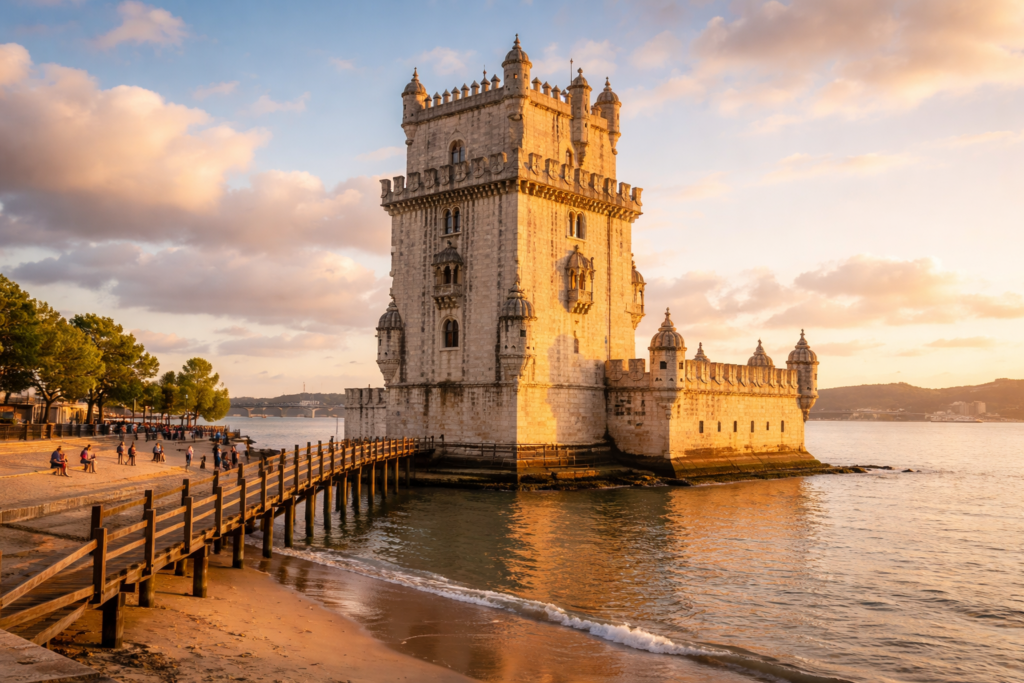
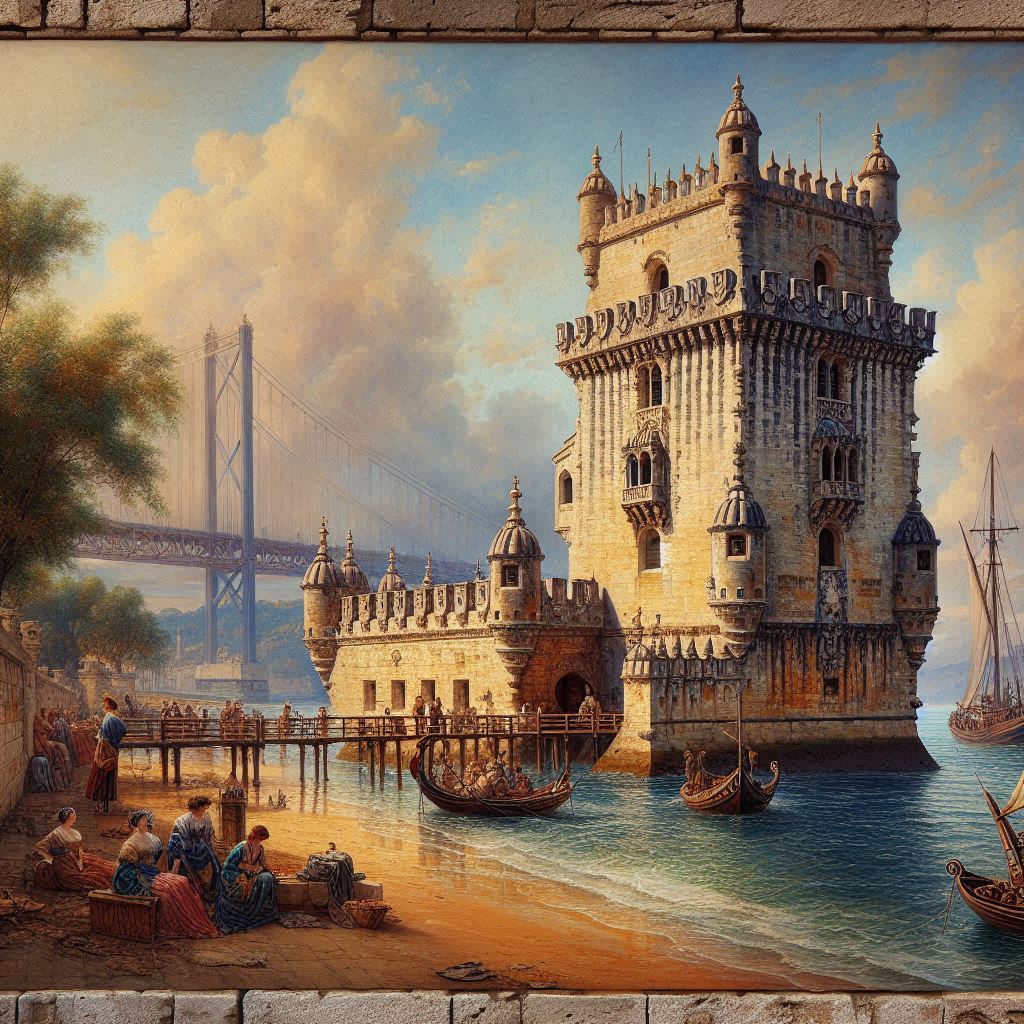
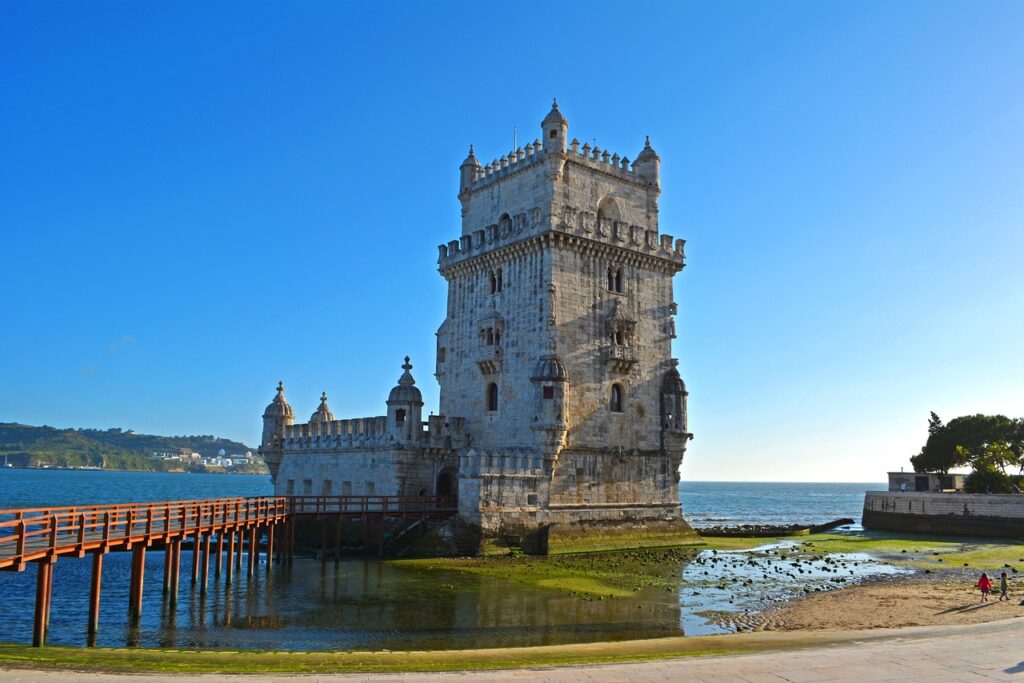
Mosteiro dos Jerónimos & Torre de Belém: Usually open, but they can be incredibly crowded during the holidays. I recommend visiting on weekdays or early in the morning if you can.
Castelo de São Jorge: This stays open every day, including Easter Sunday. It’s a great place to catch the sunset after a long lunch.
Oceanário de Lisboa: Open 365 days a year. This is a perfect “plan B” if you find other things closed on Sunday.
🛍️ Shopping: Malls vs. Local Boutiques
Portugal loves a good shopping mall (Centro Comercial), and these are your best friend for convenience during holidays.
Shopping Centers (Colombo, Amoreiras, Vasco da Gama): These typically stay open until 11:00 PM or midnight, even on the holidays. They also include large supermarkets if you need to stock up on supplies.
Baixa & Chiado: Most international brands will stay open. However, if you are looking for that specific vintage cork shop or a small bookstore, they will likely be closed on Sunday.
🍴 Easter Sunday Lunch (A Local Tradition)
In Lisbon, Easter Sunday is all about the Almoço de Páscoa. The traditional star of the show is Cabrito (roast kid) or Borrego (lamb), usually served with roasted potatoes.
Local Tip: Because this is a huge family tradition, the best traditional restaurants fill up well in advance. If you want a sit-down meal on Sunday, book your table as early as possible. Alternatively, head toward the Time Out Market (Mercado da Ribeira)—it stays open and offers a great variety of festive flavors without the need for a reservation.
🍭 Don’t miss the treats!
You cannot leave Lisbon at Easter without trying:
Folar da Páscoa: A traditional Easter bread. In Lisbon, it’s usually sweet and comes with a whole hard-boiled egg tucked into the dough (symbolizing rebirth).
Amêndoas de Páscoa: Sugar-coated or chocolate-covered almonds. You’ll see these in every Pastelaria window.
Pão de Ló: A very light, moist sponge cake that is a staple on every Portuguese table this week.
🚋 Getting Around
Public transport (Metro, Trams, and Buses) will run on a Sunday/Holiday schedule on the official public holidays. This means fewer frequent departures than on weekdays, so give yourself a little extra time.
Enjoy the spring flowers, the smell of incense near the Cathedrals, and the unique, clear light of Lisbon!
So, you’ve looked at a map of Lisbon, seen those charming narrow alleys, and thought, “I’m a hiker. I have legs. I shall conquer this city on foot!” First of all, I admire your optimism. It’s adorable. Second, to answer your question: No, you aren’t crazy—but you might be a little bit masochistic.
Lisbon is one of the most beautiful cities in the world, and yes, it is technically “walkable.” However, Lisbon doesn’t believe in flat surfaces. It is a city built on seven hills, and I’m convinced the locals added an eighth just for a laugh. Exploring Lisbon on foot is a glorious, sweat-inducing, calf-shredding adventure that will leave you with incredible photos and legs that feel like overcooked spaghetti.
Here is the honest truth about walking in Lisbon, from someone who has survived the cobblestones.
The Reality Check: Lisbon Distances vs. Lisbon Hills
On a flat map, Lisbon looks like a breeze. In reality, a 500-meter walk can involve a 45-degree incline and 200 limestone stairs that have been polished to a slippery sheen by five centuries of footsteps.
1. Baixa → Chiado → Bairro Alto
Distance: Roughly 1.5 km (0.9 miles)
The Vibe: This is the “classic” Lisbon walk. You start in the flat, majestic streets of Baixa, feel like a champion for ten minutes, and then you hit the climb to Chiado.
The Verdict: Totally doable. This is where you’ll find the best shopping and the famous Bertrand Bookstore. Just watch out for the Calçada Portuguesa (the pretty black-and-white stones); they are beautiful to look at but behave like a skating rink the moment a single drop of rain hits them.
2. Praça do Comércio → Alfama → Castelo de São Jorge
Distance: Approximately 2 km (1.2 miles)
The Vibe: This is less of a “walk” and more of a “vertical pilgrimage.” Alfama is a labyrinth of laundry-draped balconies and Fado music.
The Warning: Your GPS will give up on you here. It will tell you to turn left through a wall. Ignore it. Just keep heading upward until you see a castle. If you start seeing goats, you’ve gone too far.
3. Praça do Comércio → Cais do Sodré → Belém Tower
Distance: About 7–8 km (4.5–5 miles)
The Vibe: This is the “Marathon” route. It’s flat (praise be!), following the Tagus River. It’s scenic, breezy, and… very long.
The Verdict: If you walk this, you aren’t a tourist; you’re an athlete. Most sane people walk the first bit to Cais do Sodré and then realize they still have 6 km to go and hop on a train.
4. Belém Tower → Jerónimos Monastery
Distance: 1.5 km (0.9 miles)
The Vibe: Easy, breezy, and packed with history. This is a “chunk” walk. You take the train/tram to Belém, and then you walk between the monuments. This is the smart way to do it.
What You’ll Gain (Besides Glutes of Steel)
Why would anyone choose to walk when the iconic yellow trams exist? Because the trams are packed like sardines, and the real magic of Lisbon happens in the gaps between the tourist stops.
The “Miradouros”: These are cliffside viewpoints. If you take a taxi to the top, you miss the tiny ginjinha (cherry liqueur) stands and the street art that makes Lisbon feel alive.
Spontaneous Discoveries: You can’t find a hidden courtyard where a grandmother is grilling sardines if you’re zooming past in a Tuk-Tuk.
The Slower Pace: Lisbon is meant to be sipped, not chugged. Walking forces you to stop, look up, and appreciate the azulejos (tiles) on every building.
What You’ll Struggle With
Let’s be real: your calves will eventually declare independence and try to leave your body.
Time Efficiency: If you try to walk everywhere, you will see three things a day instead of ten.
The Heat: In the summer, the sun reflects off the white stones like a giant magnifying glass. Check out this guide on whether the tap water in Lisbon is safe to drink—spoiler: it is, so keep that reusable bottle filled!
The “Ouch” Factor: Fashionable heels in Lisbon are a death wish. If your shoes don’t have grip, you’re one slippery stone away from a very public pratfall.
The Pastéis de Nata Motivation System
If you decide to walk the long stretch from the city center to Belém, you need a reward. Specifically, a warm, custard-filled, flaky reward from Pastéis de Belém.
The Math of Motivation: Standard science (which I am definitely making up right now) suggests that a 7 km walk from Praça do Comércio to the Belém Tower burns enough energy to justify exactly three Pastéis de Nata with zero guilt. If you walk back? That’s six. At that point, you’re basically a health nut.
Survival Tips for the Lisbon Pedestrian
Walk in Chunks: Don’t try to walk the whole city. Pick a neighborhood (like Graça or Príncipe Real), take a tram there, and then explore on foot.
The Tram Rule: Trams are an “experience,” not a commute. Ride the 28 once for the photos, but don’t rely on it to get you to your dinner reservation on time—it’s often faster to walk (or crawl).
Budget Smart: Walking is the ultimate way to save money. For more tips, check out this list of free things to do in Lisbon to keep your wallet as full as your step counter.
Hydrate or Diedrate: Seriously, the hills are no joke.
The Final Verdict: Is it Crazy?
Walking Lisbon isn’t crazy—it’s the most authentic way to see the city. You’ll find the best views, the quietest alleys, and the most charming cafes by simply following your nose (and your burning quads).
Just remember: you don’t have to be a hero. It is perfectly acceptable—even encouraged—to walk until you’re tired, realize you’re at the bottom of a massive hill, and then shamelessly call a Bolt to take you the last 500 meters.
What about you? Have you ever attempted the “Great Lisbon Trek” only to be defeated by a set of stairs? Share your Lisbon walking regrets or victories in the comments below!
Lisbon has a reputation for being charming, sunny, and slightly chaotic in the best possible way. It also has a lesser-known superpower: it’s very friendly to travelers who like culture, views, and experiences but prefer not to watch their bank account cry in real time. If you’ve ever wondered whether Lisbon has free museums like London, how walkable the city really is, or how to survive a trip on a “pastel de nata budget,” this guide is for you.
Yes, you can absolutely explore Lisbon without spending much money. No, you don’t need to live on plain bread and tap water to do it (although Lisbon’s tap water is perfectly drinkable, more on that later).
Lisbon works a little differently. Most museums are not free every day, but many of them are free on specific days or at certain times. Translation: if you plan smartly, you’ll still get your culture fix without paying a cent.
Free Museum Days in Lisbon
Many state-run museums in Lisbon offer free entry on Sundays and public holidays, usually until early afternoon. This includes excellent options like:
Museu Nacional de Arte Antiga – Portugal’s most important fine art museum, with everything from medieval panels to Indo-Portuguese works.
Museu do Azulejo – A must-see if you want to understand why tiles are such a big deal in Portugal.
Museu Nacional dos Coches – Royal carriages that make your car feel deeply inadequate.
Always double-check opening hours before you go, as free periods can change. But with a bit of planning, Sunday morning in Lisbon can be a museum marathon—without the marathon-level ticket prices.
Free Attractions and Places You Can Visit Anytime
Here’s where Lisbon really shines. The city itself is basically an open-air museum, and no one charges admission to walk around looking impressed.
Miradouros: Million-Euro Views for Free
Lisbon’s viewpoints (miradouros) are legendary—and blissfully free.
Miradouro da Senhora do Monte – One of the best panoramic views in the city, especially at sunset.
Miradouro de Santa Catarina – A relaxed spot with river views and a local vibe.
Miradouro de São Pedro de Alcântara – Picture-perfect views over Baixa and the castle.
Bring snacks, sit down, and enjoy the show. The sun setting over Lisbon is one of the best free performances in Europe.
Historic Neighborhoods That Cost Nothing to Explore
Wandering Lisbon’s neighborhoods is an activity in itself:
Alfama – Narrow streets, laundry hanging overhead, and unexpected viewpoints around every corner.
Bairro Alto – Quiet by day, lively by night, always interesting.
Belém – Even if you don’t go inside the monuments, the area itself is worth the trip.
Walking these areas costs nothing and delivers more atmosphere than many paid attractions.
Free Cultural Experiences (Yes, They Exist)
Lisbon is generous with culture, even if your wallet is not feeling generous.
Churches and Cathedrals
Most churches in Lisbon are free to enter, or ask for a small donation. Highlights include:
Sé de Lisboa – The city’s oldest church, right in the heart of Alfama.
Igreja de São Roque – Modest exterior, jaw-dropping interior.
Free Events and Festivals
Lisbon regularly hosts free concerts, festivals, and outdoor events—especially in summer. Check the local calendar on https://www.guidetolisbon.com/whats-on/ for up-to-date listings of what’s happening while you’re in town.
Can You Explore Lisbon on Foot?
Short answer: yes, but your legs will notice.
Lisbon is very walkable in terms of distances, but the city is famously hilly. If you’re comfortable walking uphill (and downhill, repeatedly), you can explore large parts of the city on foot. Alfama, Baixa, Chiado, and Bairro Alto are all easy to combine in a walking day.
That said, mixing walking with public transport is often the smartest and cheapest strategy.
Budget-Friendly Transport Tips
Trams, buses, and metro are affordable and reliable.
The iconic Tram 28 is technically public transport—but often crowded. Walking parallel routes can be more pleasant and free.
Taxis and ride-hailing apps are cheaper than in many European capitals, but walking still wins for budget travelers.
How to Save Even More Money in Lisbon
Free attractions are great, but the real savings often come from daily habits.
Picnic Like a Local
Lisbon has fantastic parks and riverfront areas perfect for picnics:
Jardim da Estrela
Ribeira das Naus
Buy bread, cheese, fruit, and snacks from a supermarket or local market and enjoy a meal with a view.
Bring a Refillable Water Bottle
Tap water in Lisbon is safe and good. Refill your bottle at your accommodation instead of buying plastic bottles all day. Your wallet and the planet will both approve.
Eat Smart
You don’t need fancy restaurants every day:
Bakeries and pastelarias offer cheap meals and coffee.
Lunch menus (“prato do dia”) are often excellent value.
Making breakfast at your accommodation saves money fast.
Want More Free Ideas in Lisbon?
For more inspiration, walking routes, and detailed attraction guides, check out:
Final Thoughts: Lisbon on a Budget Is Not a Compromise
Traveling cheaply in Lisbon doesn’t mean missing out—it often means slowing down, walking more, and enjoying the city the way locals do. Free viewpoints, free museum days, historic neighborhoods, and simple pleasures like picnics and sunsets are what make Lisbon special.
Your wallet survives. Your memories thrive. And your step counter will probably file a formal complaint—but it’ll be worth it.
Ever had that feeling in Lisbon where you’ve already done the classics — Belém, Alfama, Baixa, maybe even Tram 28 — and suddenly realize you still have time? Real leftover time. Not enough for a full new plan, but too much to just sit in a café scrolling your phone.
That’s actually the perfect moment to explore what’s around Lisbon.
Because while most visitors stay tightly packed into the historic center, Lisbon is surrounded by low-key, beautiful, and slightly underrated places that almost never make it into standard itineraries. No tour buses. No strict schedules. Just beaches, villages, viewpoints, forests, and everyday Portuguese life.
Here are ten places close to Lisbon that are perfect when you have leftover time — and want something relaxed, real, and refreshingly uncrowded.
1. Azenhas do Mar – The Cliff Village That Feels Unreal
Azenhas do Mar looks like a movie set. White houses stacked dramatically on a cliff, waves crashing below, and a natural ocean pool carved into the rocks.
Most tourists rush through Sintra town or stop briefly at Cabo da Roca, but very few make it here. That’s a mistake. This place is about slowing down, eating fresh fish, and watching the Atlantic do its thing.
Come late afternoon, stay for sunset, and don’t overplan it.
2. Mata dos Medos – Pine Forest Silence Near the Ocean
Just across the river near Costa da Caparica, Mata dos Medos is a massive pine forest that somehow stays under the radar.
Walk a few minutes away from the main roads and suddenly you’re surrounded by dunes, trees, and sandy paths that feel miles away from the city. Keep walking and you’ll hit wild beaches where the crowds thin out fast.
It’s the kind of place where you accidentally spend half a day without realizing it.
3. Arrábida Convent – A Hidden Place of Absolute Calm
Tucked deep inside the hills of the Arrábida Natural Park, this old Franciscan convent feels like a secret.
White stone buildings, total quiet, and panoramic views over the Atlantic. There’s no commercial buzz here, no rush, no pressure. Just space and silence.
If Lisbon ever feels too loud, this is the reset button.
4. Aldeia de Broas – Where Time Moves Slower
Near Mafra, Aldeia de Broas is tiny. Really tiny. Stone houses, a handful of streets, locals chatting in the shade.
There’s no big attraction, no must-see sight. You stop here to feel Portugal rather than consume it. Order a coffee, say bom dia, watch the rhythm of daily life unfold.
Sometimes doing almost nothing is the best plan.
5. Praia do Magoito – Atlantic Drama Without the Hype
Sintra’s coastline is wild, and Magoito is one of its moodiest beaches.
Dark sand, steep cliffs, powerful waves, and weather that can change in minutes. It’s not polished or calm — it’s raw and beautiful.
Perfect for long walks, deep breaths, and letting the Atlantic remind you who’s in charge.
6. Sesimbra Castle – Big Views, Small Crowds
Most people go to Sesimbra for seafood by the water. Almost nobody drives up to the castle above town.
From the top, you get sweeping coastal views, fresh air, and none of the pressure you find at more famous viewpoints. It’s easy to reach and hugely rewarding.
Late afternoon is ideal, when the light softens and the crowds stay away.
7. Bucelas – Wine Country Without the Scene
Everyone talks about Douro or Alentejo wine regions. Bucelas quietly exists just north of Lisbon, producing excellent white wine with almost no tourism buzz.
Rolling hills, small producers, relaxed restaurants, and zero pretension. Order local Arinto wine, have lunch, and enjoy how normal everything feels.
It’s wine country for people who don’t like wine tours.
8. Quinta da Ribafria – Sintra Without the Chaos
Sintra’s main palaces are impressive — and crowded. Quinta da Ribafria offers something different.
Renaissance gardens, peaceful paths, historical buildings, and room to breathe. It’s ideal if you love Sintra’s atmosphere but not the shoulder-to-shoulder experience.
A perfect decompression stop after palace overload.
9. Praia da Ursa – If You Take the Easier Way
Praia da Ursa is famous, but most people only know the difficult hiking route.
There’s an easier access path if you know where to look, and that makes all the difference. Fewer people, the same dramatic rock formations, and a beach that still feels wild and untouched.
Go early, respect the place, and leave no trace.
10. Barreiro Old Town – Everyday Life Across the River
Take a ferry from Lisbon and land somewhere most tourists never consider.
Barreiro isn’t flashy, and that’s the appeal. River views, industrial history, local cafés, and a sense of everyday Portuguese life that feels refreshingly unfiltered.
It’s not about sightseeing — it’s about atmosphere.
Final Thought: Let Lisbon Breathe
Lisbon is incredible, but it doesn’t end at the city limits. If you’ve got leftover time, don’t fill it with another checklist attraction or rushed visit. Fill it with space, calm, and places that let you wander without expectations.
So, you’re planning a trip to Portugal and you’ve hit that fork in the road: Lisbon or Porto? Cue the internal debate, the endless tabs, the strong opinions from friends who’ve been to exactly one of them and now act like experts.
Let’s slow it down. Grab a coffee. No pressure. This is a lazy, honest, fun comparison — the kind you’d want to read while half-planning your trip and half-daydreaming about pastel de nata.
The Vibe: Big, Bright Lisbon vs Moody, Magnetic Porto
Lisbon is Portugal’s extrovert. It’s sun-drenched, a bit chaotic, effortlessly photogenic, and full of neighborhoods that feel like mini-cities. One moment you’re rattling uphill on a tram, the next you’re drinking vinho verde by the river, and later you’re watching the sunset from a miradouro wondering how this city gets away with being this pretty.
It’s lively, diverse, and constantly in motion. Lisbon feels like a place where things are happening — festivals, exhibitions, pop-up markets, concerts, street life. If you want to keep track, this is your go-to: 👉 https://www.guidetolisbon.com/whats-on/
Porto, on the other hand, is the cool introvert with depth. Smaller, denser, and moodier in the best way. Stone buildings, steep streets, dramatic river views, and a slightly rough-around-the-edges charm. Porto doesn’t shout; it pulls you in.
It feels more intimate, more grounded, and a bit more “authentic” in that old-soul way. People fall hard for Porto — and often don’t stop talking about it afterward.
Size & Getting Around: Easy vs Effortless
Lisbon is big. Not overwhelming big, but big enough that you’ll be using trams, metro, Ubers, and your step counter will quietly judge you. Neighborhood hopping is part of the fun, but it does take planning.
Porto is compact. You can walk most places, especially if you don’t mind hills (and you will mind them — briefly — then forget once you sit down with a glass of port).
If you love wandering aimlessly without checking Google Maps every five minutes, Porto wins. If you like variety and endless options, Lisbon has the edge.
Food & Drink: It’s Not a Competition… But Also It Is
Lisbon’s food scene is huge and international. Traditional tascas, modern Portuguese kitchens, vegan cafés, rooftop cocktails, seafood temples — you name it, it’s there. You can eat cheap or fancy, local or global, and never get bored.
Porto is more traditional, heartier, and proudly so. This is comfort food territory. Grilled meats, slow-cooked dishes, and portions that assume you skipped lunch. And then there’s port wine, which isn’t just a drink here — it’s a lifestyle.
Honestly? Lisbon wins on variety. Porto wins on soul.
Football: Okay, Let’s Talk Rivalry ⚽
If football matters to you even a little, this choice suddenly gets emotional.
Porto has FC Porto, a club with a fierce identity, international success, and a “us against the world” mentality. Porto fans are intense, loyal, and proud — and the Estádio do Dragão on match day is no joke.
Lisbon counters with not one, but two giants:
SL Benfica – historically massive, wildly popular, and supported by half the country.
Sporting CP – famous for developing world-class talent and for doing things their own way.
So… who’s best?
Historically? Benfica and Porto dominate. Internationally? Porto punches above its weight. Atmosphere? All three deliver — differently.
If you’re a football fan, Lisbon gives you options. Porto gives you focus.
Sights & Attractions: Variety vs Consistency
Lisbon is layered. Alfama, Belém, Baixa, Bairro Alto, LX Factory — each area feels distinct. There’s history, viewpoints, river walks, museums, and day trips baked right in. If it’s your first time, this guide helps pull it all together: 👉 https://www.guidetolisbon.com/
Porto is visually consistent in a good way. The Ribeira, the Douro, the bridges, the tiled facades — it’s cohesive and cinematic. You don’t “tick off” Porto; you absorb it.
If you love checking off landmarks, Lisbon keeps you busy. If you love atmosphere over lists, Porto quietly wins.
Distance: How Far Apart Are Lisbon and Porto?
The distance between Lisbon and Porto is about 313 km.
By train:
High-speed Alfa Pendular: ~2.5–3 hours
Comfortable, scenic, reliable
By car:
About 3 hours on the highway
Easy drive, good roads
So yes — they’re very well connected.
Can You Combine Lisbon and Porto in One Trip?
Absolutely. And honestly? You probably should.
A classic combo looks like this:
3–4 days in Lisbon
2–3 days in Porto
You get the energy of the capital and the charm of the north without feeling rushed. The train ride itself is part of the experience, and you don’t lose a full day traveling.
This is one of those rare cases where “why not both?” is genuinely the best answer.
Day Trip to Porto from Lisbon: Is It Realistic?
Technically? Yes. Practically? Meh.
You can catch an early train, spend a few hours in Porto, and come back late. But Porto deserves more than a whirlwind stroll and one rushed lunch.
If you’re tight on time, focus on Lisbon and save Porto for another trip. If you’re tempted enough to consider a day trip, that’s your sign to add at least one overnight stay.
Nightlife & Evenings: Buzz vs Cozy
Lisbon nights are long. Rooftop bars, live music, Bairro Alto chaos, riverfront cocktails — you can keep going as long as you want.
Porto evenings are slower, cozier, and wine-centric. Think long dinners, river reflections, and conversations that accidentally last three hours.
Party energy? Lisbon. Romantic evenings? Porto.
So… Which City Should You Choose?
Choose Lisbon if you:
Love big cities with personality
Want variety, events, and energy
Enjoy mixing sightseeing with nightlife
Like having endless options
Choose Porto if you:
Prefer compact, atmospheric cities
Love food, wine, and moody views
Want a slower, deeper experience
Fall for places with strong character
And choose both if you can. Portugal makes it easy, affordable, and incredibly rewarding to experience more than one city in a single trip.
When we think of the Second World War, images of bombed-out cities, occupied territories, and fierce battles immediately come to mind. Lisbon, however, tells a different story. Portugal, under the authoritarian rule of António de Oliveira Salazar, declared neutrality at the start of the war. This neutrality transformed Lisbon into a unique place in wartime Europe: a city untouched by bombing, yet buzzing with intrigue, diplomacy, espionage, and the desperate hopes of thousands of refugees seeking a way out of the continent. While much of Europe was engulfed in destruction, Lisbon became a lifeline to the free world, a stage for spies, and a haven of escape. Below we explore the most frequently asked questions about Lisbon during the Second World War.
Was Portugal neutral during World War II?
Yes, Portugal maintained neutrality throughout the conflict. Salazar skillfully balanced relationships with both Axis and Allied powers. Portugal had a long-standing alliance with Britain, dating back to the 14th century, yet it also maintained trade relations with Germany. This delicate balancing act allowed Portugal to avoid direct involvement in the war, preserving its cities, including Lisbon, from devastation.
Did Lisbon suffer bombings during WWII?
No. Unlike other European capitals, Lisbon was spared the horrors of aerial bombardment. The city remained intact throughout the war years. This alone made Lisbon a beacon of safety for refugees and diplomats. Hotels remained open, cafés bustled with life, and ships continued to sail from its harbor while much of Europe lay in ruins.
Why was Lisbon important in WWII?
Lisbon became one of the few functioning gateways out of Europe. Its strategic Atlantic port allowed ships to sail to the Americas, and its airports connected travelers to North Africa and beyond. Refugees who had lost everything could still reach freedom via Lisbon. At the same time, the city was a hub for information gathering. Diplomats, journalists, spies, and traders all converged in Lisbon, making it a critical node in wartime networks.
Did Jewish refugees pass through Lisbon?
Yes, Lisbon became a crucial escape route for Jewish refugees fleeing Nazi persecution. Thousands of Jews who had managed to cross the Pyrenees into Spain eventually found their way to Lisbon. From here, they boarded ships bound for the United States, Brazil, and Palestine. The city’s role as a point of transit saved countless lives. Lisbon’s streets, cafés, and embassies were filled with exhausted refugees hoping to secure passage to safety.
Could you really catch a ship to freedom from Lisbon?
Yes. Lisbon’s harbor remained one of the last open doors to freedom during the war. Ships like the Serpa Pinto regularly carried passengers to New York, Brazil, or Havana. Tickets were expensive and scarce, but for many refugees this was the final chance to escape Nazi-occupied Europe. The city became a place where lives balanced on a knife’s edge—secure a ticket, and you had a future; fail, and you risked being trapped once more.
Was Lisbon full of spies during WWII?
Absolutely. Lisbon earned the nickname “City of Spies.” British, American, German, and Soviet agents filled the city’s cafés, hotels, and nightclubs. Information was traded constantly, as agents watched each other, tried to influence Portuguese officials, and intercepted valuable intelligence. Espionage thrived in Lisbon precisely because of its neutrality: it was a place where enemies could move in close proximity without openly clashing.
Did Lisbon inspire spy novels or movies?
Yes. The atmosphere of Lisbon during the war—its crowded hotels full of refugees, its smoky cafés filled with whispering men in trench coats, its ships ready to cross the Atlantic—inspired many writers. Graham Greene, who worked for British intelligence, drew inspiration from wartime Lisbon. The city has often been compared to Casablanca, another legendary port of intrigue. To this day, Lisbon retains a sense of mystery tied to its WWII reputation.
Did Portugal secretly help the Allies?
Although neutral, Portugal did lean toward the Allies at crucial moments. A key example was tungsten (wolfram), a mineral critical for armaments. Portugal exported tungsten to both Germany and Britain, but as the war progressed, it increasingly supported the Allied side. In 1943, Portugal granted Britain and the United States access to air bases in the Azores, which became essential for controlling Atlantic shipping lanes and launching operations.
Was life in Lisbon normal during the war?
Life in Lisbon was unusual: both normal and extraordinary at the same time. On the surface, daily routines continued. Trams ran through the streets, markets stayed open, and the city’s cafés and fado houses remained lively. Yet beneath this calm, Lisbon was filled with uncertainty. Food shortages and rationing occurred, though less severely than in much of Europe. The city was crowded with refugees, diplomats, and spies, creating an atmosphere unlike any other in Europe at the time.
Did famous people pass through Lisbon?
Yes, many notable figures found themselves in Lisbon during the war. The Duke and Duchess of Windsor transited through Portugal after fleeing France. The artist Marc Chagall was among the many Jewish refugees who passed through Lisbon on their way to the United States. Politicians, aristocrats, intellectuals, and writers all crossed paths in the city, turning Lisbon into a cultural crossroads during Europe’s darkest years.
Aristides de Sousa Mendes – The Portuguese Hero
Aristides de Sousa Mendes was the Portuguese consul in Bordeaux in 1940. Against Salazar’s strict orders, he issued thousands of visas to Jewish families and other refugees, allowing them to escape through Portugal to safety. Many of them continued their journey via Lisbon to other parts of the world. Although he was punished by the regime at the time, today he is honored as a national hero of Portugal and recognized by Yad Vashem as one of the Righteous Among the Nations.
Can Sousa Mendes Be Compared to Raoul Wallenberg or Oskar Schindler?
Can Aristides de Sousa Mendes be compared to Raoul Wallenberg in Budapest or Oskar Schindler in Krakow? In many ways, yes. Just as Wallenberg saved Budapest’s Jews with protective passports and safe houses, and Schindler shielded his workers from deportation by employing them in his factories, Sousa Mendes used his diplomatic authority to issue visas that saved thousands of lives. All three operated in different environments: Wallenberg in Nazi-occupied Hungary, Schindler at the very heart of the German system, and Sousa Mendes in neutral but authoritarian Portugal. What unites them is moral courage and conscience: they chose humanity over blind obedience. While their circumstances and methods were not the same, they remain powerful examples of how individual decisions can resist overwhelming evil and alter the course of countless lives.
Five Books Worth Reading to Better Understand Lisbon and Portugal During the Second World War
1. Neill Lochery: Lisbon: War in the Shadows of the City of Light, 1939-1945 – Perhaps the most comprehensive historical account of the subject. It vividly explains how Lisbon became a center for refugees, spies, and diplomats, while Portugal maintained its delicate neutrality.
2. Ronald Weber: The Lisbon Route – Entry and Escape in Nazi Europe – Focuses specifically on the escape routes that passed through Lisbon. The book shows how crucial the city was as a gateway for those fleeing Nazi persecution.
3. Anne Sebba: Les Parisiennes (sections on Lisbon) – Although primarily about Paris, this book touches upon Lisbon as a vital transit point for French women and refugees. It situates Lisbon within the broader wartime European network.
4. David Lodge: Author, Author! (fictional perspective with Lisbon references) – A novel that blends literature, history, and the refugee experience. While fictional, it captures the unique atmosphere of the city during the war years.
5. David Leite: The New Portuguese Table (with cultural and culinary insights) – Not strictly a WWII history book, but it provides insight into Portuguese life and culture, including food and traditions that carried on even during the war years. It complements historical works by offering a more human and cultural perspective.
Together, these books – ranging from strict history to fiction and cultural reflections – provide a fuller picture of what life in Lisbon and Portugal was like during the turbulent years of the Second World War.
Conclusion
Lisbon during the Second World War was a paradox: a city at peace in a continent at war. It was a haven for refugees, a playground for spies, and a delicate balancing act for Portugal’s leaders. While much of Europe was in ruins, Lisbon remained intact, its role as a neutral port making it a last lifeline to freedom. Today, its wartime legacy lives on in stories of courage, like those of Aristides de Sousa Mendes, and in the memory of thousands who passed through its streets on their way to safety. For travelers and history enthusiasts, Lisbon offers not only beautiful architecture and sunny squares, but also a deep and fascinating connection to one of the most turbulent times in modern history.
One of the most common questions travelers ask before visiting Portugal is: “Can I drink the tap water in Lisbon?” The answer is simple: yes, the tap water in Lisbon is perfectly safe to drink. Portugal, and especially Lisbon, has very high standards when it comes to water treatment, and the city’s supply is regularly monitored to ensure safety. For locals, it is completely normal to drink straight from the tap, and you will see restaurants offering tap water if you ask for “água da torneira.”
Where Does Lisbon’s Water Come From?
Lisbon gets its water primarily from rivers and reservoirs located in central Portugal. The Tagus River basin is one of the main sources, and water is carefully treated before it reaches homes and hotels. The water passes through modern purification plants where it is filtered, disinfected, and tested to meet both Portuguese and European Union safety standards. This means that when you fill your glass in Lisbon, you are drinking water that is subject to strict quality controls and frequent analysis.
Does the Water Have a Special Taste?
While the water is safe, some travelers notice that Lisbon’s tap water has a slightly different taste compared to what they are used to back home. This often comes from the mineral composition of the soil and reservoirs, and sometimes a light chlorine flavor from the disinfection process. For most people, this is hardly noticeable, but if you are particularly sensitive to taste, you might prefer to use a reusable bottle with a built-in filter or opt for bottled water, which is widely available and inexpensive.
Can Sensitive Stomachs Handle Lisbon Tap Water?
For the vast majority of visitors, Lisbon tap water causes no problems at all. However, if you have a very sensitive stomach or a condition that makes you cautious about water abroad, you may want to start slowly. Sometimes, it is not the bacteria (since Lisbon water is disinfected and bacteria-free), but simply the unfamiliar mineral content that can make digestion feel different at first. In these cases, bottled water can be a good temporary alternative until your body adjusts.
Staying Hydrated in Lisbon’s Summer Heat
Lisbon is famous for its hills and sunshine, but that also means you need to pay extra attention to hydration. In July and August, temperatures often rise above 30°C (86°F), and the combination of steep climbs, narrow streets, and sightseeing can make you sweat quickly. Doctors generally recommend drinking about 2 liters of water per day, but when walking up and down Lisbon’s hills in the summer, you should aim for 3 liters or more, especially if you are outside during the hottest hours of the day (12:00–16:00). Always carry a reusable water bottle with you; many public fountains around the city provide safe, drinkable water to refill your bottle for free.
What Else to Drink in Lisbon?
Of course, you may not always want to drink plain water. Luckily, Lisbon offers plenty of other refreshing options:
Fresh juices and smoothies: Many cafés in Lisbon serve freshly squeezed orange juice, smoothies, and seasonal fruit juices. Portugal’s oranges are famous for their sweetness, so don’t miss trying one of these natural drinks.
Coffee: Portuguese coffee is strong, aromatic, and part of everyday life. Order a “bica” (Lisbon’s version of espresso) for a quick pick-me-up while sightseeing.
Local wines: Portugal is one of Europe’s most celebrated wine producers. Lisbon itself has excellent regional wines, and enjoying a glass of white vinho verde or a robust red from Alentejo is part of the cultural experience. Just make sure to alternate with water to stay hydrated!
Ginjinha: This cherry liqueur is a Lisbon specialty. Served in tiny cups, it’s sweet, strong, and perfect for tasting Portuguese tradition.
Beer: Local beers such as Sagres and Super Bock are refreshing on a hot day, and you’ll find them everywhere from corner kiosks to waterfront restaurants.
Conclusion – Tap Water and Drinks in Lisbon
In short, Lisbon’s tap water is safe, clean, and perfectly fine to drink, though some visitors may notice a slightly different taste. If your stomach is particularly sensitive, you can always choose bottled water in the first days, but for most people, there are no issues. During the hot summer months, staying hydrated is key, especially when exploring Lisbon’s famous hills. Alongside water, make sure to try Lisbon’s wide variety of drinks – from fresh juices and strong coffee to local wines and ginjinha. Drinking water is essential, but in Lisbon, enjoying what else is in your glass is part of the adventure.
Let me guess. You were SO excited to finally visit Lisbon. You saw the photos—sunsets over tiled rooftops, pastel de nata in hand, your hair flowing in the Atlantic breeze. But now you’re here, sweating like a rotisserie chicken, surrounded by 437 tourists all trying to take the same photo in Alfama. You can’t feel your feet anymore, and someone just elbowed you while trying to selfie with a tram.
Welcome to high-season Lisbon. It’s stunning. It’s chaotic. It’s also about 3°C away from turning into an oven. But worry not! There’s a secret side to the city—quiet places where locals retreat, where birds outnumber influencers, and where you might just regain your will to live. Let me show you where to go when you’re hot, overwhelmed, and just want a moment of peace in this beautiful madness.
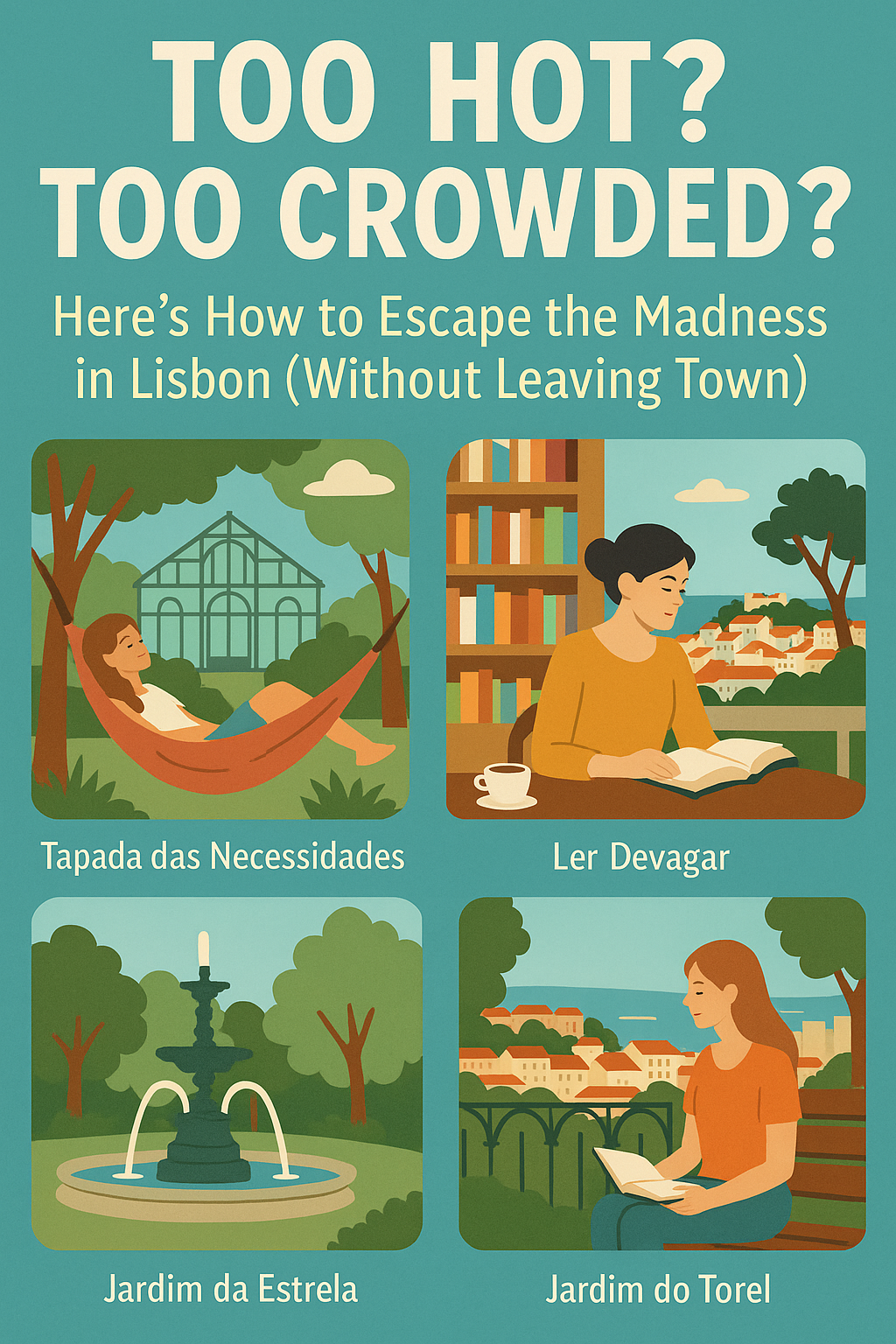
🌿 1. Tapada das Necessidades – The Garden No One Knows Exists
Why go: It’s green, quiet, and slightly overgrown like nature forgot to shave. Where: Near the Alcântara neighborhood, just a 10-minute walk from the National Museum of Ancient Art. Best for: Hammock time, journaling, staring into space.
This place sounds like it belongs in a fantasy novel, and honestly, it kind of looks like one too. Picture an abandoned greenhouse, ducks waddling past old fountains, and barely another soul in sight.
Locals come here to nap, bring a sketchpad, or just lie under the trees and pretend they’re not supposed to be answering work emails. You’ll find space to breathe, leafy paths to wander, and even a small viewpoint overlooking the river. No screaming tour groups. No tram bells. Just you and the trees.
📚 2. Ler Devagar – The Bookshop/Café That Feels Like a Brain Spa
Why go: It’s indoors and air-conditioned. Need I say more? Where: LX Factory, in the Alcântara district. Best for: Cooling off with a book, pretending to be an intellectual.
Ler Devagar (literally “Read Slowly”) is the kind of place you walk into and think, “Yes, I do need a novel in Portuguese I’ll never finish.” Books line the walls up to the ceiling, and there’s a suspended bicycle hanging mid-air—because of course there is.
Grab a coffee (they won’t judge you if you’re just here for the AC), flip through a quirky photography magazine, and let the calm wash over you. If you’re lucky, someone will be playing quiet jazz, and your cortisol levels will drop by half.
Bonus: The entire LX Factory is worth exploring if you want a hipster break from the heat. There are hidden terraces, art galleries, and even tattoo parlors, if that’s how you relieve stress.
🪟 3. Miradouro da Senhora do Monte – For Sunsets Without Elbows
Why go: The best views of Lisbon with fewer sweaty bodies. Where: In the Graça neighborhood, a bit of a climb but worth every step. Best for: Romantic moments, peaceful reflections, or just Instagram without photobombers.
Tourists flock to Miradouro da Graça or Santa Catarina like pigeons to breadcrumbs. But if you walk a little further uphill (yes, uphill, sorry), you’ll be rewarded with the miradouro of your dreams.
It’s more spacious, less noisy, and often includes locals playing soft guitar or just vibing with a beer and a view. Come at sunset. Sit on the wall. Watch the trams crawl below. You’ll remember why you came to Lisbon in the first place.
Just bring water, because the climb might make you question your life choices.
🍃 4. Jardim da Estrela – The Chill Park Across From the Basilica
Why go: Feels like a Victorian garden party, minus the corsets. Where: Right in front of Basílica da Estrela. Best for: Picnics, naps, squirrel-watching, toddler-dodging.
This is one of the prettiest and calmest parks in Lisbon. Locals love it, especially families, older couples, and sunburned expats who need a breather. There are palm trees, ponds, peacocks (if you’re lucky), and those old-fashioned green benches made for staring into the void.
You can grab a drink from the café in the middle, stretch out on the grass, and mentally unsubscribe from your group WhatsApp chat. There’s even a playground if you’ve brought small humans along for the ride.
Pro tip: Visit the nearby Estrela Market for snacks or ice cream before settling into your personal oasis.
🧘 5. Jardim do Torel – The Secret Garden in the Middle of the City
Why go: A peaceful refuge just steps from Avenida da Liberdade. Where: Tucked away in Santo António, near the top of Elevador do Lavra. Best for: Solo escapes, journaling, sighing deeply with joy.
This garden is so hidden that even many locals haven’t been. It’s perched high on a hill but sheltered by trees, with a little café, shaded benches, and views that sneak between the buildings like a postcard waiting to happen.
The atmosphere is calm, the breeze is cool, and it’s almost shocking how peaceful it is given how central the location is. You can sit here for hours. Maybe sketch. Maybe write a poem. Maybe do absolutely nothing and be completely justified in it.
☕ Bonus: Quiet Cafés Where Nobody Will Ask to Share Your Table
Heim Café – Alcântara. Great brunch and they let you linger.
Hello Kristof – Trendy and quiet in Cais do Sodré.
The Mill – Bica area. Australian-Portuguese coffee haven.
Quase Café – Next to Miradouro da Graça. Little, lovely, peaceful.
Final Thoughts (and an Invitation to Breathe)
Lisbon is amazing, but it’s not always easy—especially during high season. Between the hills, the heat, and the humanity, it can all get a bit much. So don’t feel guilty for stepping away from the must-sees to give your brain (and your feet) a break.
These calm corners and quiet places aren’t just a break from the noise. They’re part of Lisbon’s soul too—just the softer, slower part that doesn’t shout for your attention.
Do you know another secret spot in Lisbon that deserves some love? Or do you have questions about the places above? I’d love to hear from you!
For more Lisbon tips, stories, and guides, check out Guide to Lisbon. It’s got you covered—from famous sights to hidden delights.
Planning a trip to Lisbon this winter and not sure what to pack? You might be staring at your suitcase wondering: Do I bring a swimsuit or a wooly sweater? Let’s break it down so you don’t end up freezing on the beach — or sweating through your parka.
What’s Winter Like in Lisbon?
Winter in Lisbon is pretty mild compared to the rest of Europe. You won’t see blizzards or frozen sidewalks here, but don’t expect tropical beach vibes either.
Here’s what you’re looking at for average temperatures:
December: Highs around 15°C (59°F), lows around 9°C (48°F)
January: Highs around 14°C (57°F), lows around 8°C (46°F)
February: Highs around 15°C (59°F), lows around 9°C (48°F)
So yes — you’ll want a warm jacket, especially for evenings, but leave the snow boots at home.
Does It Snow in Lisbon?
Nope. Snow in Lisbon is super rare — like, once-in-a-blue-moon rare. The city’s coastal climate keeps it too warm for snow, even in the coldest months. Rain? Yes, you’ll probably get some. Snow? Almost never.
Will My Apartment or Hotel Have Heating?
Most hotels will definitely have heating, but some older apartments or budget stays might not be as toasty. Portuguese homes aren’t always built with central heating in mind, so if you’re renting an apartment, double-check that it has space heaters or AC units with heating mode. A cozy blanket and some hot tea might become your best friends.
Can You Swim in the Sea?
Technically? Yes. Realistically? Only if you’re brave. The Atlantic is chilly in winter, averaging around 15-17°C (59-63°F). Some surfers still go out (with wetsuits, of course), but casual swimming isn’t super popular unless you’re one of those cold-water thrill-seekers. So maybe save the swimsuit space for something else — unless your hotel has a heated indoor pool.
Why Visit Lisbon in Winter?
There are actually some great perks to coming in the off-season:
Fewer crowds: You’ll have the sights (almost) to yourself. No elbowing your way through Belém or waiting in line for ages at the castle.
Cheaper prices: Flights and accommodation tend to be more affordable. Your budget will stretch further.
Authentic experience: With fewer tourists, you’ll get a more local feel — perfect for cozy cafés, Fado nights, and quiet strolls through the neighborhoods.
Want to Know What’s Happening in Lisbon?
Even in winter, the city is full of events, festivals, and cultural happenings. Check out What’s On for the latest on concerts, exhibitions, markets, and more.
So, no need for snow gear — but bring a warm jacket, a few layers, and maybe a raincoat. Winter in Lisbon is all about relaxed vibes, beautiful light, and enjoying the city without the summertime hustle.